
Battery Basics
Curious how battery backup systems work and whether one is right for your home?
This section breaks down the core concepts in plain language — helping you make a smart, informed investment in energy security.

What You Will Learn
- How battery backup systems work
- The difference between whole-home and partial backup
- Smart load systems vs. standard panels: why it matter
- What to know about adding a battery to your existing solar
- How to estimate battery runtime during an outage
- Key battery terms every homeowner should know
What Is a Battery Backup System?
A home battery backup system is an energy storage solution that provides electricity to your home when the power goes out. It can charge from your solar panels, the grid, or a generator. Battery systems are quiet, clean, and respond instantly when an outage occurs and require very little maintenance.
Battery backups are often installed with solar, but they can also operate independently. When designed properly, these systems provide peace of mind and long-term energy resilience.
Partial vs. Whole Home Battery Backup: What's the Difference?
One of the first choices you'll make when considering a backup system is whether to back up just essential appliances (partial backup) or your entire home (whole home backup). Your decision depends on your energy priorities, home layout, and budget.
Partial Home Battery Backup: Resilience Where It Counts
Partial battery backup systems are designed to power a home's most essential circuits—commonly known as critical loads. Rather than supporting the entire home, these systems prioritize what matters most during an outage: refrigeration, internet connectivity, lighting in key areas, and the operation of vital components like a gas furnace blower, security equipment, or a sump or well pump if present. For homeowners seeking a reliable solution without the cost of full-home backup, partial systems strike a thoughtful balance between affordability and functionality.
When engineered properly, a partial backup system can deliver one to three days of continuous power under managed usage. But true resilience requires more than just stored energy—it requires a plan to recharge. That’s why we recommend integrating a renewable or supplemental power source into every system design. Whether through solar, a generator, or a hybrid combination of both, daily battery replenishment ensures extended performance during long-duration outages. This approach allows a home to remain operational far beyond the battery’s initial charge window, providing a meaningful layer of protection during grid failures.
To better understand how these systems are planned and optimized, explore our guide on battery backup system design strategies, which explains how loads, priorities, and energy sources are balanced for real-world performance.
Partial systems also require a dedicated critical loads panel to separate and prioritize backed-up circuits. While these systems don’t support high-demand appliances like HVAC, electric ovens, or laundry equipment, they deliver peace of mind by keeping your home’s core functions running when the grid goes down. Designed with the Pacific Northwest in mind, these systems are built for real-life conditions, not just best-case scenarios—ensuring your home stays connected, comfortable, and prepared.
Whole Home Battery Backup
A whole-home battery backup system is designed to support every circuit in your home during a grid outage—but with smart energy planning at its core. While it provides access to full-house functionality, including HVAC systems, water heaters, washers and dryers, and kitchen appliances, it's important to understand that battery size and inverter output ultimately determine how many of these loads can run at once.
Even with a high-capacity system, simultaneous operation of heavy-draw appliances is not always practical. That's why whole-home backup doesn't mean "everything all at once"—it means everything is accessible, but used strategically. Systems are engineered to prioritize comfort and convenience while balancing real-time power demands. Intelligent load management tools can automate which appliances run and when, helping extend battery runtime and maintain stability during extended outages.
When paired with solar, a generator, or both, the battery can be recharged regularly—often daily—enabling a homeowner to sustain near-normal operations even during multi-day outages. While installation is more complex and the system capacity typically ranges from 30–60+ kWh, the payoff is unmatched control, comfort, and preparedness. With thoughtful use, whole-home backup delivers flexible, lasting energy resilience.

Smart Load vs. Standard Battery Systems
Not all battery backup systems are created equal—especially when it comes to how they manage energy during a power outage. The key difference between a standard battery system and a smart load battery system lies in how they distribute power across your home’s circuits when the grid goes down. A standard battery backup system is typically configured to support either a partial backup panel (covering select critical loads like lighting, internet, and refrigeration) or, in some cases, is wired to back up the entire main panel in a whole-home setup. However, these systems do not distinguish between essential and non-essential loads once the battery activates.
In practical terms, this means the homeowner is responsible for manually managing energy use. If high-draw appliances like the oven, air conditioner, and clothes dryer are all operating at once, the system may overload, shut down, or rapidly drain its stored energy. Without automated prioritization, the system grants access to everything—but demands careful attention to avoid mismanagement. This kind of configuration works best in simpler setups, where the backup need is limited to a few known loads, or in homes with very large batteries and predictable usage patterns. While standard systems are dependable and effective, they lack the flexibility to dynamically respond to real-time power needs or optimize performance during extended outages.
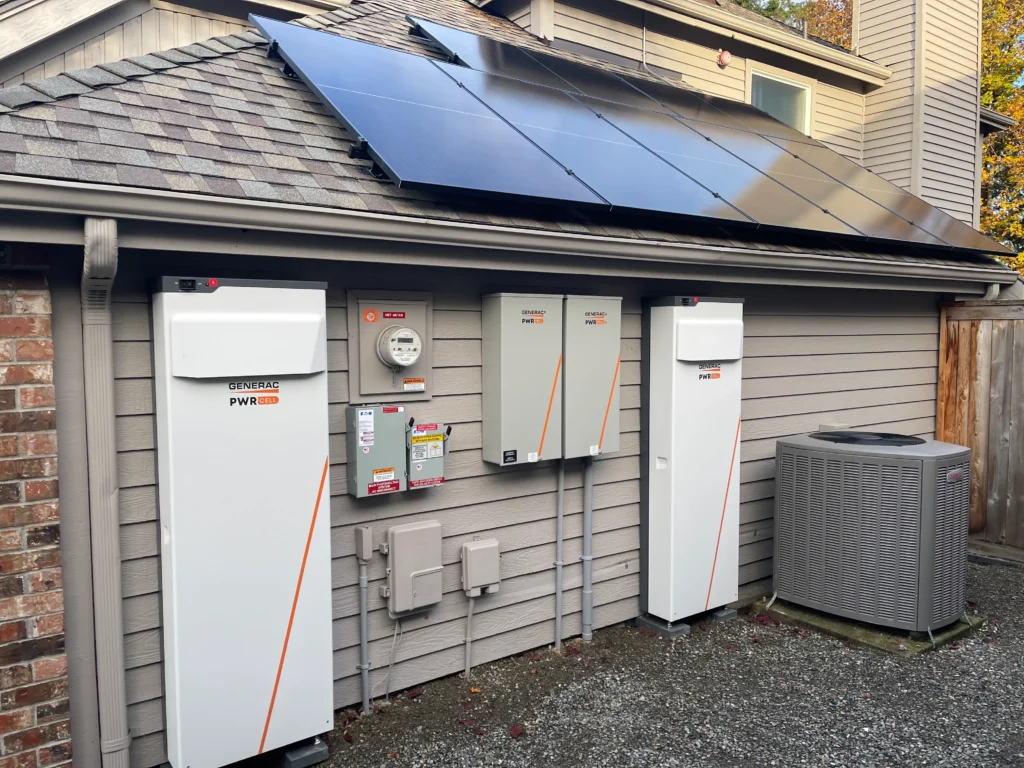
By contrast, smart load battery systems introduce a higher level of efficiency and control. These systems use advanced load management technology—such as SPAN panels, Generac PWRmanager, or Enphase Load Controllers—to monitor and regulate which circuits are powered based on real-time battery capacity, solar generation, or generator input. With smart systems, essential loads like heating, refrigeration, Wi-Fi, and lighting remain powered automatically, while less critical loads, such as EV chargers or laundry appliances, are delayed or cycled off to conserve energy. These systems also adapt dynamically to changing conditions, adjusting output to stretch battery life across multi-day outages and responding to available energy resources in real time.
Another key advantage of smart load systems is remote control and customization. Homeowners can use a mobile app to turn specific circuits on or off, monitor energy usage, and reassign priorities depending on weather, battery charge, or personal preferences. By reducing unnecessary drain, these systems extend battery life and ensure more stable, safe operation—without requiring constant user input.
Smart load systems are particularly beneficial for homes with limited battery capacity but a desire for whole-home flexibility. They also excel in situations where outage durations are unpredictable or when homeowners want granular, hands-free control over their energy use. Deciding between a standard and smart load battery system ultimately comes down to your goals, lifestyle, and backup expectations. For those who prioritize simplicity and are comfortable managing usage manually, standard systems can offer reliable backup at a lower upfront cost. But for those seeking maximum resilience, automation, and long-term energy flexibility, smart load systems provide a future-ready solution.
As utility rates rise, outages become more frequent, and home energy demands grow more complex, smart load systems are quickly becoming the gold standard—especially when paired with solar and/or generator integration. They turn your home into a responsive, intelligent energy hub capable of navigating whatever comes next.If you want to explore battery system types, load management strategies, and real-world use cases in more detail, visit our Battery Learning Center for in-depth guides.

Why It Matters:
A smart load system helps your battery last longer, maintain power to the most important appliances, and prevent system overload. This is especially valuable in the Pacific Northwest, where outages may last for days.
How Long Will a Battery Backup System Keep My Home Powered?
One of the most common questions about home battery systems—especially in the outage-prone Pacific Northwest—is: “How long will it last?” The answer depends on more than just the size of the battery. It’s a function of capacity (kWh), power output (kW), home usage, and whether the system is recharged daily using solar, a generator, or both—as most resilient systems are designed to do.
Battery capacity is measured in kilowatt-hours (kWh), which tells you how much total energy your system can store. For example, a 20 kWh battery can theoretically deliver 2 kilowatts (kW) of power continuously for 10 hours. But real-world usage depends on how many appliances you’re running and for how long.
Power output, measured in kilowatts (kW), defines how much electricity the system can deliver at any moment. A battery with a 10 kW output can run more devices at once than a system limited to 5 kW, even if both store the same amount of energy. That’s why it’s important not only to look at how many hours a battery might last, but also how many appliances it can power simultaneously without tripping a limit.
For outages longer than a few hours, battery runtime becomes less about stored energy and more about how effectively it can be recharged. That’s why most robust systems today are built to include solar panels, a backup generator, or both. These sources allow the battery to refill every 24 hours—supporting extended, even indefinite outages with the right design. A typical partial backup system using 10–20 kWh and solar/generator input may keep essentials like refrigeration, internet, and lighting running for several weeks at a time.
More comprehensive systems with 30–60+ kWh of storage and 9–13 kW of power output can support whole-home functionality—but even then, users must prioritize or stagger large appliance loads like HVAC, or electric ovens to avoid overloading the system or draining the battery too quickly.
With proper system sizing, smart load management, and daily recharging, a battery backup system becomes not just a stopgap—but a dynamic, renewable-powered solution that keeps your home running with confidence, no matter how long the grid is down.

Power for Days, Weeks, or Months: How Battery Backup Becomes a Long-Term Solution
While a standalone battery system can offer reliable backup power for several hours or even a day or two—especially when supporting just essential circuits—its true potential is unlocked when paired with a renewable recharge strategy and smart energy management. When batteries are integrated with rooftop solar, a generator, or both, and governed by intelligent load controls, they transform from short-term backup into long-duration power solutions capable of supporting a home for weeks, months, or even indefinitely.
A high-performing system begins with proper sizing. Battery capacity, measured in kilowatt-hours (kWh), is carefully matched to your home’s critical energy demands. For example, a 20–40 kWh system might be sufficient for partial-home backup, while 60+ kWh may be needed to support whole-home usage—especially if heating, cooking, or EV charging is included. But beyond stored energy, it’s the design of the system—how it’s recharged and how power is distributed—that defines true resilience.
To sustain long outages, the battery must recharge every 24 hours. Solar panels generate renewable power during the day, replenishing the battery even as you use energy in real time. If weather, smoke, or winter conditions limit solar performance, a generator fills the gap—ensuring consistent charging regardless of sunlight. Many systems in the Pacific Northwest combine both, offering redundancy and peace of mind through seasonal and storm-related challenges.
Smart load management plays an equally critical role. Instead of allowing every circuit to draw power at once, modern systems use intelligent controllers to prioritize what gets power and when. During extended outages, the system may automatically delay non-essential loads, cycle appliances to reduce drain, or shift usage to align with available solar production. Homeowners can also adjust preferences manually via app-based controls.
The result is a fully adaptive energy system—one that responds to the environment, maximizes efficiency, and provides power day after day. It’s no longer just about making it through the night; it’s about maintaining comfort, safety, and independence for the long haul. With the right design, battery backup is not just emergency support—it’s a cornerstone of long-term energy resilience.
Can I Add a Battery to My Existing Solar System?
Yes, in many cases you can add a battery to an existing solar system—but the ease and cost of doing so depends heavily on how your original system was designed. Not all solar arrays are battery-ready. Some were installed for grid-tied net metering only, without any provision for backup power or energy storage. In these cases, upgrading to include a battery requires careful engineering and sometimes substantial modification.
One of the first things a qualified installer will evaluate is the type of inverter in your current system. Many older or budget-friendly solar installations use string inverters that are not compatible with battery storage. These may need to be replaced with a hybrid inverter (which can handle both solar and storage) or augmented with additional components like AC-coupled batteries that operate alongside the existing setup. In contrast, systems built with microinverters or battery-ready hybrid inverters may be easier and more cost-effective to retrofit.
The method of integration also matters. In a DC-coupled system, solar energy flows directly to the battery before being converted for home use, offering higher efficiency but requiring compatible equipment. An AC-coupled system—where the battery charges using already-converted AC power—can be more flexible for retrofits but may be slightly less efficient and require more complex wiring or permitting.
Just as importantly, adding a battery doesn’t automatically mean your system will provide backup power during an outage. Many older solar arrays are grid-tied only, meaning they shut down when the grid goes down—even if the sun is shining. To enable true backup capability, your system may need to be reconfigured with islanding protection, a critical loads panel, or a whole-home transfer switch.
Local building codes, utility interconnection requirements, and permit pathways also play a role. Some jurisdictions may require rewiring or updated compliance documentation to add storage to a pre-existing solar array.
The best way to determine your options is a through professional engineering review. This ensures that your system—whether new or legacy—can be safely and efficiently paired with a battery, and that it will function reliably when you need it most. In many cases, a retrofit can be a smart investment, transforming a simple grid-tied system into a resilient, energy-independent home energy solution.
Final Takeaway: A Smarter Way to Power Your Future
Battery backup systems have moved far beyond temporary outage protection. Today, they form the backbone of modern home energy resilience—supporting essential needs during blackouts, enabling long-duration operation through solar and/or generator recharging, and giving homeowners real-time control over how and when they use power.
But batteries don’t work in isolation. The difference between a system that simply stores energy and one that transforms your home into a smart, self-sustaining power hub lies in how it’s engineered. System size, inverter capacity, load prioritization, and recharge strategy must all work together. Whether you're backing up a few critical circuits or your entire home, performance comes down to smart planning—not just battery size.
With extreme weather events on the rise, an aging power grid, and accelerating utility rates—especially in the Pacific Northwest—battery storage offers a forward-looking solution that pays dividends in comfort, continuity, and energy autonomy. And with technologies like smart load management and hybrid recharge systems, it’s now possible to maintain power for days, weeks, or even indefinitely.
The best battery backup system isn’t just installed—it’s designed for your life. With the right configuration, you’re not just preparing for the next outage. You’re building a smarter, more flexible, and future-ready
🔍 Battery Backup Glossary
| Term | Definition |
|---|---|
| kWh (Kilowatt-Hour) | A measure of energy capacity. One kilowatt-hour powers a 1,000-watt device for one hour. Batteries are sized in kWh to show how much energy they can store. |
| Battery Capacity | The total amount of electricity a battery can store, usually expressed in kilowatt-hours (kWh). More capacity = more backup time. |
| Partial Backup | A system that powers only essential or “critical” circuits during an outage, like the fridge, lights, and internet. |
| Whole Home Backup | A system designed to power all electrical circuits in the home, including HVAC, laundry, kitchen appliances, and more. |
| Critical Loads Panel | A separate electrical subpanel installed to isolate and power only selected essential circuits during a power outage. Required for partial backup systems. |
| Smart Load Management | A system that prioritizes or sequences power delivery to different appliances, extending battery life and avoiding overload. |
| Sequencing | Temporarily powering high-demand appliances (like a well pump) on a rotating schedule, rather than all at once, to preserve battery capacity. |
| Energy Management Software | Software that monitors and controls your home’s energy use — often part of a smart load system. It makes real-time decisions about what to power based on conditions. |
| Inverter | A device that converts DC electricity from solar panels or batteries into usable AC power for your home. A hybrid inverter can handle both solar and battery functions. |
| Retrofit | Adding a battery to an existing solar system. Not all systems are battery-ready and may require upgrades to support this. |
| State of Charge (SoC) | The current level of charge in a battery, expressed as a percentage (e.g., 100% full, 20% remaining). |
| Depth of Discharge (DoD) | The percentage of the battery’s capacity that has been used. For example, if you’ve used 8 kWh from a 10 kWh battery, DoD is 80%. |
| Cycle Life | The number of complete charge/discharge cycles a battery can perform before it degrades below its rated capacity. |
| AC vs. DC Coupling | Refers to how solar and battery systems are wired together. AC-coupled systems are easier for retrofits; DC-coupled systems are more efficient for new builds. |
| Grid-Tied | A system that is connected to the utility grid. When solar produces excess power, it sends it to the grid (and possibly earns credits via net metering). |
| Off-Grid | A fully self-contained system that operates without any connection to the utility grid. Requires larger batteries, solar, and often a generator. |
| Time-of-Use (TOU) Rates | Utility rate plans where electricity costs vary based on the time of day. Battery systems can store cheap electricity and discharge during peak-rate times to save money. |
| Transfer Switch | An electrical switch that changes your home’s power source from the grid to your battery system during an outage. |
Factors That Influence Pricing
- Battery Size & Capacity: Larger batteries with higher storage capacity cost more but provide longer continuous energy independence.
- Battery Type: Lithium-ion batteries are more expensive than lead-acid batteries but offer greater efficiency and longevity.
- Brand & Features: Smart batteries with intelligent load management provide more value but may have a higher initial cost.
Long-Term Benefits & Savings
While the upfront investment may seem significant, homeowners benefit from lower electricity bills, increased home value, and available tax incentives. The 30% Federal Tax Credit and Washington state sales tax waiver significantly reduce costs.
If you’re in Washington, Clean Energy Innovators provides expertly engineered solar battery backup solutions tailored to your energy needs.
FAQs About Solar Battery Backup Systems
1. Do I need a solar battery backup if I have solar panels?
Yes. Advanced solar energy systems alone do not provide power during grid outages. Without a battery, excess solar energy is sent to the grid instead of being stored for later use.
2. How long can a solar battery power my home during an outage?
Backup duration depends on your battery’s capacity, energy usage, and which appliances are running. A 10 kWh battery can typically support essential loads—like a refrigerator, a few lights, and internet equipment—for 12 hours, depending on how conservatively energy is used. If additional appliances like a furnace fan, well pump, or microwave are running, backup time may be much shorter.
The definition of “essential” varies by household, and real-world usage often drains batteries faster than expected. Systems with intelligent load management—such as Generac PWRmanager—can extend backup time by automatically shedding or staggering non-critical loads.
Without such features, managing usage manually becomes essential to prolong battery life during outages.
3. Can I add a battery backup to an existing solar system?
It’s possible, but often requires significant upgrades. Many existing systems—especially those with older string inverters or microinverters—aren’t battery-ready. Adding backup may involve installing a new inverter, using an AC-coupled battery like the Tesla Powerwall, and adding a critical load panel or transfer switch.
Permitting and electrical upgrades may also be needed. Integration is feasible, but it can be complex and costly depending on your current setup.
4. What maintenance is required for solar batteries?
Most lithium-ion solar batteries need minimal maintenance. Regular system monitoring ensures optimal performance while occasional firmware updates improve efficiency.